
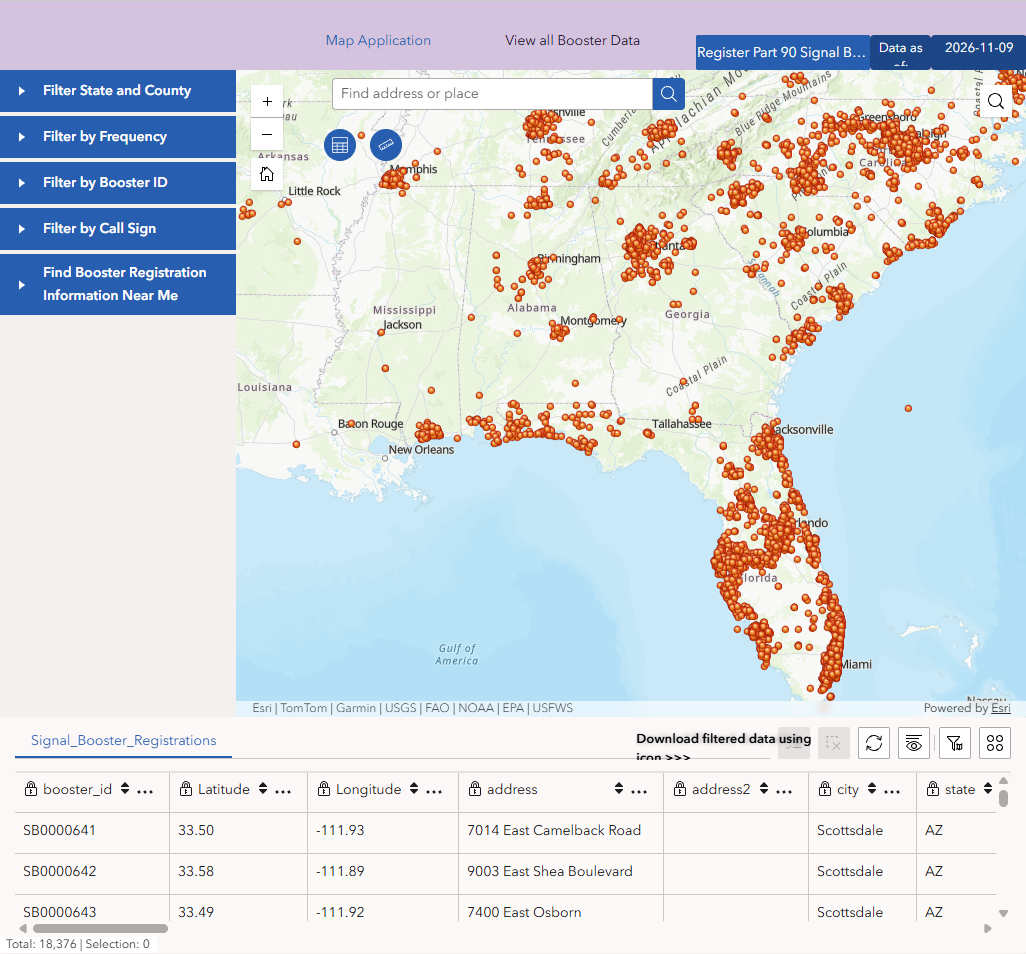
On November 9, 2026, the Federal Communications Commission (FCC) launched a new registration system for Part 90 Class B signal boosters. The FCC’s Part 90 Signal Boosters page now links to the new tool, which runs on Esri’s ArcGIS platform. At launch, the system listed 18,376 registered signal boosters.
What Is New
The registration requirement is not new. The new part is the tool for registering and searching Class B installations. The new system shows registered boosters on a map and in a data table. It has the following features:
- Filters by state and county, frequency, booster ID, and call sign
- A “Find Booster Registration Information Near Me” search
- A way to download filtered data
- A link for registering a Part 90 signal booster
Registration is still free of charge.
The Rule Has Been in Place Since 2013
On February 20, 2013, the FCC released a Report and Order in WT Docket No. 10-4. It set the current Part 90 signal booster rules. Among other things, it:
- Made clear that a non-licensee who wants to operate a signal booster must get consent from each licensee whose signals the booster will amplify
- Required registration of all existing and future Class B signal booster installations
- Allowed fixed Class B boosters and prohibited mobile Class B boosters
The rule at 47 CFR § 90.219(d)(5) states: “Class B signal booster installations must be registered in the FCC signal booster database that can be accessed at the following URL: www.fcc.gov/signal-boosters/registration.”
Existing Class B installations had to be registered by November 1, 2014. After that date, operating an unregistered existing Class B booster is unauthorized and subject to enforcement action. Any new Class B booster has to be registered before it operates.
Class A and Class B Signal Boosters
- Class A signal booster: Retransmits signals on one or more specific channels. A booster is Class A if none of its passbands is wider than 75 kHz.
- Class B signal booster: Retransmits any signals within a wide frequency band. A booster is Class B if any of its passbands is wider than 75 kHz.
Only Class B installations have to be registered with the FCC. Class A installations do not appear in the FCC system.
Why the Database Matters
The FCC created the database as a permanent, searchable record of Class B installations. When licensees experience interference or other problems with their systems, they can search it to find nearby signal boosters. That lets them identify and shut down boosters that are causing harmful interference.
SBC’s Work on RM-12009
The launch comes about a month after SBC and APCO met with FCC staff in Washington, DC. On October 6, 2026, SBC and APCO met with staff from the Public Safety and Homeland Security Bureau, the Wireless Telecommunications Bureau, and the Enforcement Bureau to discuss SBC’s Part 90 Signal Booster Petition for Rulemaking, RM-12009. We discussed three models for holding licensee consent records. One of them was an expanded FCC Signal Booster Registration System. (Read the meeting summary.)
In that meeting, we also showed staff the South Carolina ERCES & BDA Dashboard. It also runs on Esri ArcGIS. The dashboard showed 995 approved booster installations and 16 pending. South Carolina has received 1,011 consent applications since 2019, and about 74 percent of them are for Class A boosters. Because Class A boosters are exempt from FCC registration, they do not appear in the FCC’s system.
What Members Should Do
- Integrators, installers, and building owners: Use the new system to confirm that your Class B installations are registered. Register any new Class B installation before it goes into operation, and get consent from each affected licensee.
- AHJs and public safety licensees: Use the map, the filters, and the “Near Me” search to look up Class B registrations in your jurisdiction.