
On October 6, 2026, the Safer Buildings Coalition met in person with Federal Communications Commission staff in Washington, DC, to discuss SBC’s Petition for Rulemaking on Part 90 signal boosters (RM-12009). SBC Managing Director John Foley and Founder Seth Buechley were joined by Steve Devine, Chief Technology Officer of APCO International. Staff from the Public Safety and Homeland Security Bureau, the Wireless Telecommunications Bureau and the Enforcement Bureau attended. SBC filed the required ex parte notice, with the full presentation attached, on October 7.
The problem
Signal boosters in Emergency Responder Communications Enhancement Systems (ERCES) carry first responders’ radio signals into buildings. The FCC rules that govern them are vague and inconsistently applied, which leads to interference with public safety radio systems and confusion about compliance. A single poorly installed booster can degrade communications across an entire public safety radio system. Local governments bear the cost of finding it: Fairfax County, Virginia has spent more than $400,000 on test equipment alone.
SBC filed its petition in July 2025, asking the FCC to set clear, enforceable rules for these boosters. By the December 18, 2025 reply deadline, 64 parties had commented. All 58 filers who addressed the question agreed the interference problem is real. 53 of the 57 who took a position supported the petition in whole or in part.
Why SBC is narrowing its request
SBC told FCC staff that the original petition was broader than the first step needs to be, for four reasons.
- The problem is growing and the FCC has not acted. More than a year after filing, there is still no proceeding, even though every stakeholder who addressed the issue agrees it is real. South Carolina’s statewide records show booster consent requests roughly doubling over the last two years.
- The objections were about new burdens on licensees. Where commenters did not support the petition, their concern was that it would impose new regulations and obligations on radio system operators, the license holders.
- Private conversations with stakeholders confirmed that concern.
- Public safety pointed to the central gap. APCO, the Puget Sound Emergency Radio Network (PSERN) and others agreed that the core problem is the lack of a formal process for requesting and granting permission to rebroadcast public safety frequencies, and of a consistent place to record those decisions. FCC rules already require a building’s booster operator to get the licensee’s express consent. What is missing is a standard way to ask for it, grant it, and find it later.
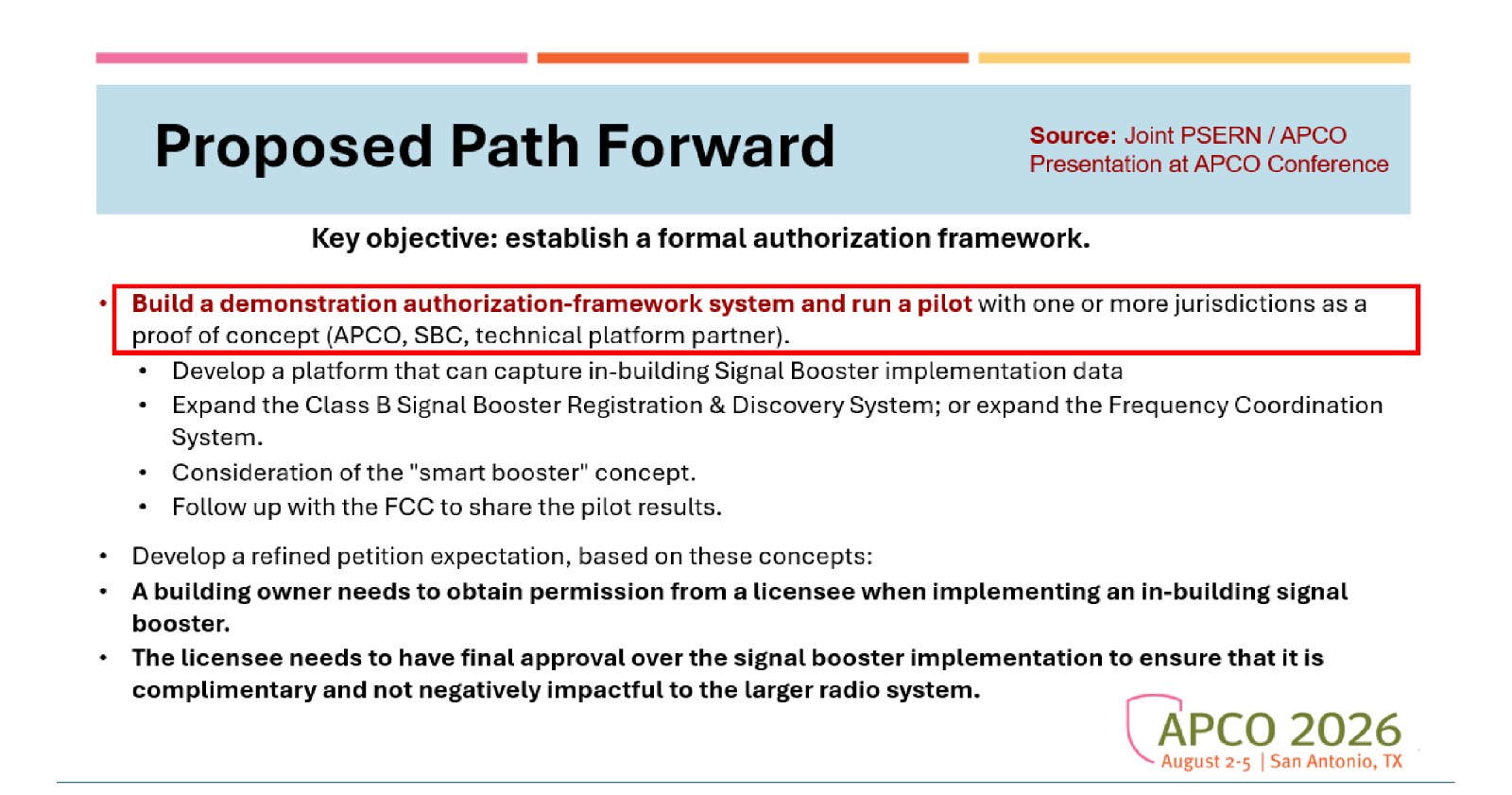
SBC will file a supplement narrowing its request to that gap: an authorization framework with a consistent process for requesting and granting licensee consent, and a designated record where the consent is kept. Licensee authority would not change. Licensees would still review, grant, condition or refuse consent as they do today. What changes is where the result is recorded, so that anyone investigating interference can look up where a booster is and who approved it, instead of spending days hunting for it.
The rest of the original petition is deferred for future consideration:
- licensee evaluation standards and response timelines
- campus and multi-building requirements
- equipment labeling
- personnel qualifications
- network protection features such as automatic shutdown
Who knows where the boosters are?
The FCC’s formal complaint numbers are small: 17 investigations in 2023, and 14 in 2024 through October 3, where a Part 90 booster was the interference source. The record explains why. Most incidents are found and fixed by licensees, vendors and building maintenance providers, and never reported.
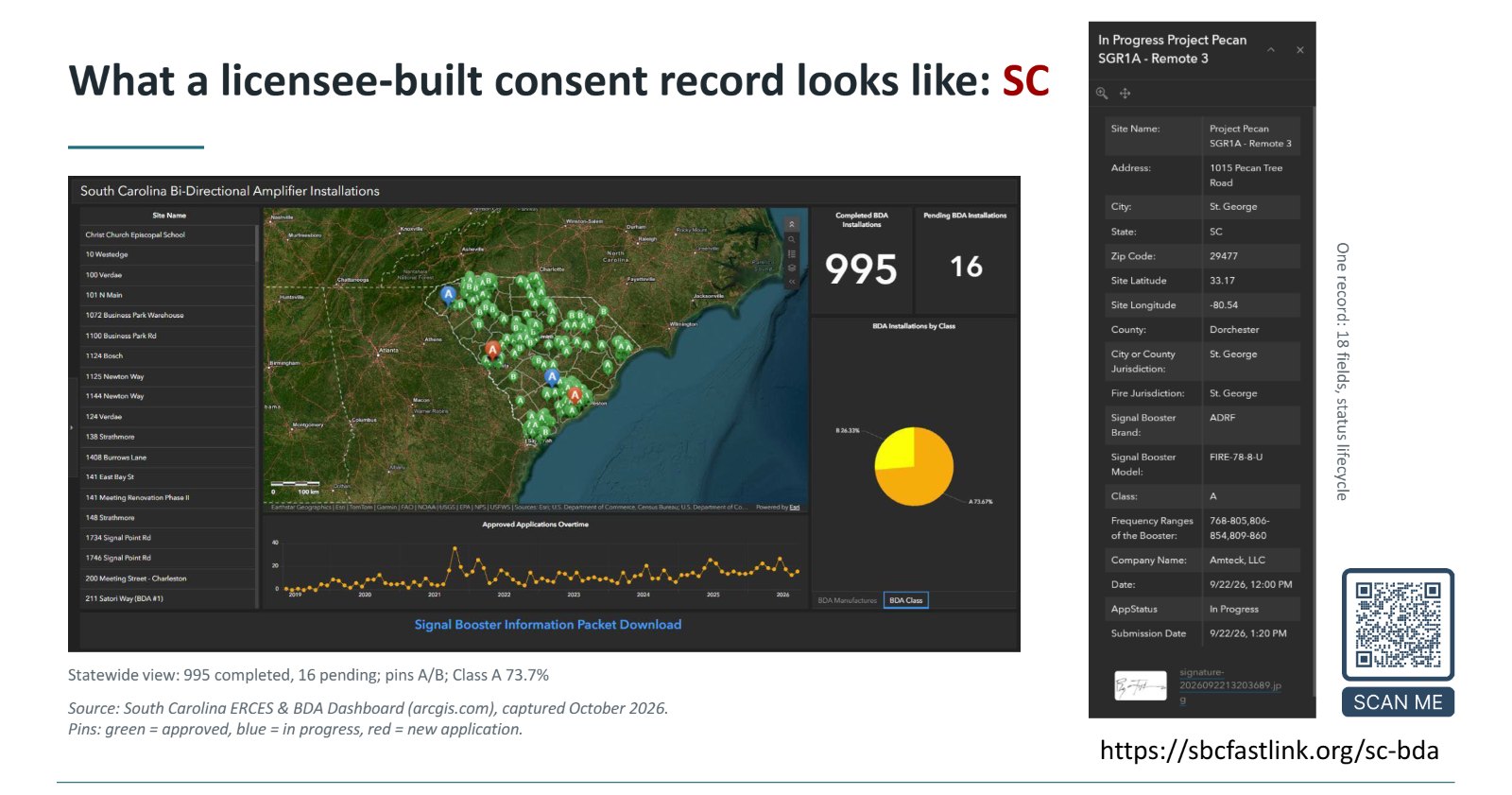
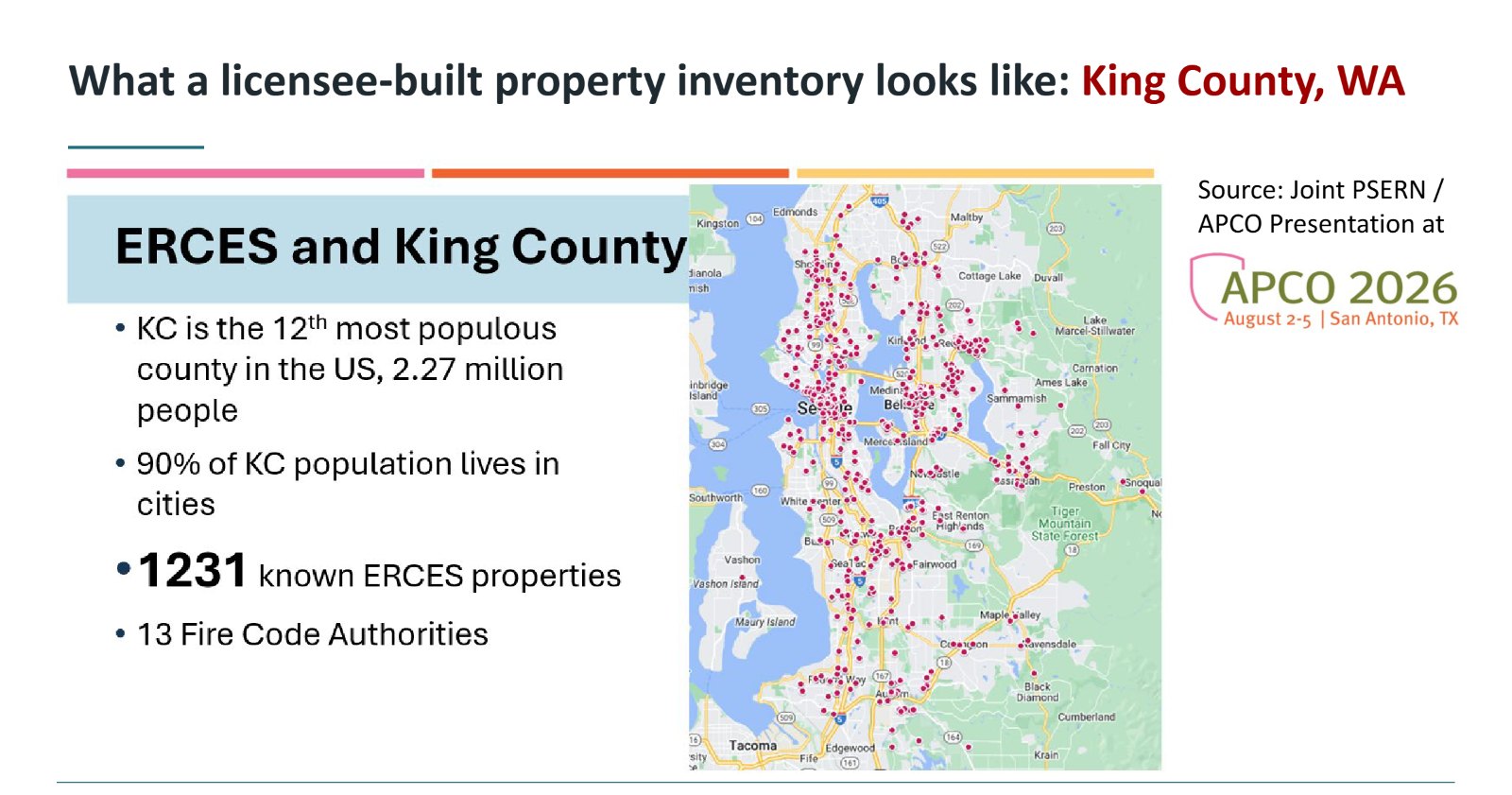
Some licensees have built their own tracking systems, and SBC compared three of them with the FCC’s Signal Booster Registration System:
- South Carolina has received 1,011 consent applications since 2019. 74 percent are Class A boosters, which are exempt from FCC registration.
- The District of Columbia’s Office of Unified Communications tracks about 430 booster systems in its own records. The FCC system shows eight registrations for the District.
- PSERN has identified 1,231 properties with ERCES. After nine rounds of notices, 158 have still not been reached.
Three ways to keep the record
SBC presented three models for who would hold the record:
- Certified administrators (SBC’s preferred approach). The FCC sets requirements by rule and certifies one or more private administrators to run systems that meet them, as it has done for TV white space, the CBRS Spectrum Access System and 6 GHz Automated Frequency Coordination.
- Extending the role of certified Part 90 frequency coordinators.
- Expanding the FCC’s own Signal Booster Registration System.
Under the first two models, the building owner or its representative would pay a submittal fee. Licensees, jurisdictions and the FCC would pay nothing. Under the third, the FCC would bear the cost.
A working model
To test whether this can work without new obligations on licensees, SBC is building a working model with the DC Office of Unified Communications, which is both a radio licensee and the District’s fire code authority. APCO International supports the effort. The model uses test data and will begin pilot operation shortly.
What SBC asked the FCC
SBC asked staff:
- which of the three models the supplement should propose
- whether recording consent should be mandatory for the booster operator
- what else would make the supplement useful to staff
- whether the Enforcement Bureau would consider an advisory restating the existing consent requirement
- whether staff would like to observe the pilot
- whether the FCC would consider extending registration to all booster classes, with the consent attached and status and expiration fields added
What’s next
SBC plans to file its supplement before the end of the year.
Background: FCC Petition for Rulemaking – Part 90 Signal Boosters (March 9, 2026)